
If you’re currently sponsoring a family member for a green card, pay close attention: U.S. Citizenship and Immigration Services (USCIS) has quietly rolled out new editions of the three core affidavit of support forms, and the old versions are no longer accepted. Knowing that USCIS can also move to deny applications now also without sending out Requests for Evidence (though now not common practice) we share this with you so you can be at ease in your immigration journey.
What Changed
On August 24, 2026, USCIS published updated editions of:
- Form I-864, Affidavit of Support Under Section 213A of the INA — the standard affidavit of support
- Form I-864EZ, Affidavit of Support Under Section 213A of the INA — the streamlined version for simple cases
- Form I-864A, Contract Between Sponsor and Household Member — used when a household member’s income helps a sponsor qualify
Each form now carries an edition date of 08/24/26, printed at the bottom of the page on both the form and its instructions. USCIS did not provide a grace period this time: the prior editions became invalid almost immediately, with the cutover taking effect around August 31, 2026. In practice, that means any I-864, I-864EZ, or I-864A submitted on an old edition after that date risks rejection or a request for evidence, which can delay an already time-sensitive filing.
If you have a pending or upcoming adjustment of status, immigrant visa interview, or removal of conditions filing that requires an affidavit of support, the safest move is to confirm you’re working from the most current edition before you sign and submit anything.
A Quick Refresher: What These Forms Actually Do
Form I-864 is the main affidavit of support. By signing it, a sponsor is making a legally enforceable promise to the U.S. government to financially support the immigrant they’re sponsoring. That obligation isn’t symbolic — it’s a contract, and it doesn’t expire just because the sponsored immigrant gets their green card. It continues until the immigrant:
- Becomes a U.S. citizen;
- Earns 40 qualifying quarters of coverage under the Social Security Act (generally about 10 years of work history);
- Leaves the United States and gives up lawful permanent resident status;
- Is covered by a new affidavit of support after removal proceedings and a new grant of adjustment of status; or
- Dies.
One detail sponsors often overlook: if the immigrant later receives means-tested public benefits — think Medicaid or SNAP — during the period the I-864 is enforceable, the sponsor can now be required to reimburse the agency that paid out those benefits. Sponsors are also obligated to file Form I-865 to notify USCIS of a change of address within 30 days of moving, for as long as the support obligation remains active. Also, the sponsor must consent to a credit report check to see if they also qualify to be a sponsor (that’s something new).
Before signing, every sponsor should be able to answer two threshold questions: Are you a U.S. citizen, U.S. national, or lawful permanent resident? And are you domiciled in the United States or one of its territories? Both are eligibility requirements to serve as a sponsor at all. The sponsor also has to be making enough income to sponsor the person depending on if they are in active duty in the U.S. armed forces or not (see below chart).
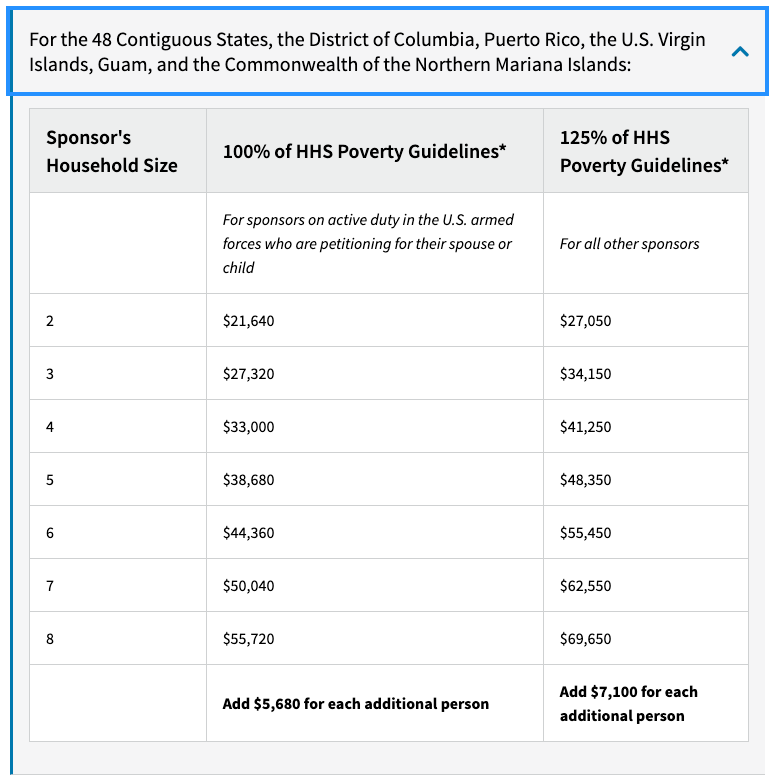
Form I-864A (Contract Between Sponsor and Household Member) comes into play when the primary sponsor’s income alone doesn’t meet the 125% federal poverty guideline threshold. It lets a qualifying household member — a spouse, parent, or adult child living at the same address, for example — pool their income or assets to help the sponsor qualify. Both the primary sponsor and the household member must sign it, and it’s submitted together with the main I-864.
Form I-864EZ is a shortcut, not a separate obligation. It’s only available when the situation is genuinely simple: the sponsor personally filed the I-130 petition, there’s a single sponsored immigrant, the sponsor is relying solely on their own earned salary or pension, and that income can be shown with one W-2 or tax return matching the amount claimed. If a joint sponsor or a household member’s income is needed to qualify, I-864EZ isn’t an option — the sponsor has to file the standard I-864 instead.
Which Form Do You Actually Need?
Getting it wrong can mean a rejected filing or a lengthy request for evidence at exactly the moment you can least afford the delay. The right form depends on how many people are being sponsored, whose income is being used to meet the poverty guideline, and how that income is documented.
If you’re not sure whether your household income situation calls for the standard I-864, the streamlined I-864EZ, or an I-864A alongside your main affidavit, that’s worth sorting out before you file — not after USCIS sends back a notice. An immigration attorney can walk through your specific numbers and household composition and tell you exactly which combination of forms fits your case.
This article is for general informational purposes and does not constitute legal advice. Immigration cases are fact-specific — consult a licensed immigration attorney about your particular situation.
https://www.uscis.gov/green-card/green-card-processes-and-procedures
https://www.uscis.gov/green-card/green-card-processes-and-procedures/affidavit-of-support
https://www.uscis.gov/green-card/green-card-processes-and-procedures/affidavit-of-support