
Immigrant Visa Processing Updates for Nationalities at High Risk of U.S. Public Benefits Reliance.
On February 2, 2026 – “President Trump has made clear that immigrants must be financially self-sufficient and not be a financial burden to Americans. The Department of State is undergoing a full review of all screening and vetting policies to ensure that immigrants from high-risk countries do not unlawfully utilize welfare in the United States or become a public charge.
Effective January 21, 2026, the Department of State paused all visa issuances to immigrant visa applicants who are nationals of the following countries:
Afghanistan, Albania, Algeria, Antigua and Barbuda, Armenia, Azerbaijan, Bahamas, Bangladesh, Barbados, Belarus, Belize, Bhutan, Bosnia and Herzegovina, Brazil, Burma, Cambodia, Cameroon, Cape Verde, Colombia, Cote d’Ivoire, Cuba, Democratic Republic of the Congo, Dominica, Egypt, Eritrea, Ethiopia, Fiji, The Gambia, Georgia, Ghana, Grenada, Guatemala, Guinea, Haiti, Iran, Iraq, Jamaica, Jordan, Kazakhstan, Kosovo, Kuwait, Kyrgyz Republic, Laos, Lebanon, Liberia, Libya, Moldova, Mongolia, Montenegro, Morocco, Nepal, Nicaragua, Nigeria, North Macedonia, Pakistan, Republic of the Congo, Russia, Rwanda, Saint Kitts and Nevis, Saint Lucia, Saint Vincent and the Grenadines, Senegal, Sierra Leone, Somalia, South Sudan, Sudan, Syria, Tanzania, Thailand, Togo, Tunisia, Uganda, Uruguay, Uzbekistan, and Yemen. ”
But, an Opinion and Order came from the Southern District of New York (Judge Jeannette A. Vargas), on August 21, 2026, in Catholic Legal Immigration Network, Inc. (CLINIC) et al. v. Rubio et al., No. 26-CV-00858 (JAV), stating that on January 14, 2026, the State Department announced a suspension of immigrant visas for nationals of 75 countries (effective January 21, 2026), directing consular officers via cable to refuse visas under INA § 221(g) to applicants from those countries, on the theory they were “high risk” of becoming public charges.
Plaintiffs (CLINIC, African Communities Together, and 11 individual visa applicants/petitioning U.S. citizens) argued the policy violated the INA’s anti-discrimination provision, exceeded the Secretary of State’s authority, and improperly bypassed individualized visa adjudication.
Key Points from the Order:
- “The nationality-based immigrant visa suspension policy embodied in the Announcement and the Cable (the “Policy”) thus has the effect of categorically banning the issuance of immigrant visas to nationals of nearly 40% of the world’s countries.”
- “Plaintiffs in this case—Catholic Legal Immigration Network, Inc. (“CLINIC”), African Communities Together (“ACT”), applicants for immigrant visas from designated countries, and United States citizens who are sponsoring family members from designated countries for immigrant visas—have brought this action seeking, inter alia, vacatur of the Policy and declaratory relief. […] The Court holds that the Policy is contrary to law and was issued in excess of Secretary Rubio’s statutory authority. The Policy is therefore vacated under the Administrative Procedure Act (“APA”).” (See Page 2 of 61 of the Judicial Order).
- The Immigration and Nationality Act, INA under 8 U.S.C. § 1101 et seq., governs the admission of noncitizens into the United States and visa processing. Under the INA, a noncitizen seeking to enter the country must generally obtain a visa, which is a travel document issued by a U.S. consular officer. See 8 U.S.C. § 1201(a); A visa does not itself authorize entry into the United States; rather, it permits the holder to travel to a port of entry and request permission to enter the United States. See 8 U.S.C. § 1201(h);
- Visas are divided into two categories – Immigrant (permanent U.S. Relocation), and Nonimmigrant (temporary U.S. Relocation).
- All immigrant visa applications must ultimately be adjudicated by a consular officer. “The INA confers upon consular officers exclusive authority to review applications for visas, precluding even the Secretary of State from controlling their determinations.” 8 U.S.C. §§ 1104(a), 1201(a)); see 8 U.S.C.§ 1104(a). And, Consular officers exercise this authority subject to the eligibility requirements in the statute and corresponding regulations.
- When a visa application has been properly completed in accordance with the INA, a consular officer must issue the visa or refuse the visa under 8 U.S.C. § 1201(a) or (g) or other applicable law. 22 C.F.R. § 42.81(a), The INA’s implementing regulations prohibit a consular officer from refusing a visa other than “upon a ground specifically set out in the law or implementing regulations.” Id. § 40.6. If refusing a visa, the consular officer is required to inform the applicant of the provision of law or regulation upon which the refusal is based. Id. § 42.81(b).

- One ground particularly relevant to the present action is Section 212(a)(4)(A) of the INA, codified at 8 U.S.C. § 1182(a)(4)(A). The so-called public charge provision renders inadmissible any noncitizen “who, in the opinion of the consular officer at the time of application for a visa, . . . is likely at any time to become a public charge.” 8 U.S.C. § 1182(a)(4)(A). While the INA “does not define ‘public charge,’” U.S. Dep’t of Homeland Sec., 969 F.3d at 51, the Second Circuit has construed the term to mean “a non-citizen who cannot support himself, in the sense that he is incapable of earning a livelihood, does not have sufficient funds in the United States for his support, and has no person in the United States willing and able to assure that he will not need public support,” id. at 74-75 (cleaned up). In other words, “Congress intended the public charge ground of inadmissibility to apply to those non-citizens who were likely to be unable to support themselves in the future and to rely on the government for subsistence.” (see the Order page 6).
- “Congress has further provided five factors that consular officers “must consider when determining whether a non-citizen is likely to become a public charge: the non-citizen’s ‘(1) age; (2) health; (3) family status; (4) assets, resources, and financial status; and (5) education and skills.’” U.S. Dep’t of Homeland Sec., 969 F.3d at 53 (brackets omitted) (quoting 8 U.S.C. § 1182(a)(4)(B)(i)). Likewise, DOS’s official guidance directs consular officers to “look at the totality of the applicant’s circumstances at the time of visa application” when “considering the likelihood of an applicant becoming a ‘public charge.’” 9 FAM 302.8-2(B)(2). In making that determination, “many factors are relevant, including age, health, family status, assets, resources, financial status, education, and skills.” 9 FAM 302.8-2(B)(2), (3). Accordingly, “[n]o single factor, other than the lack of a qualifying affidavit of support, in accordance with INA 213A, if required, will determine whether an individual is a public charge.” Id. 302.8-2(B)(3).”
- “Moreover, the INA provides that “no person shall receive any preference or priority or be discriminated against in the issuance of an immigrant visa because of the person’s race, sex, nationality, place of birth, or place of residence.” 8 U.S.C. § 1152.”
- Plaintiffs have Article III standing; the consular nonreviewability doctrine doesn’t bar this forward-looking challenge; the policy is final, reviewable agency action, citing that family separation and the lost opportunity to receive an immigrant visa gave them that standing.
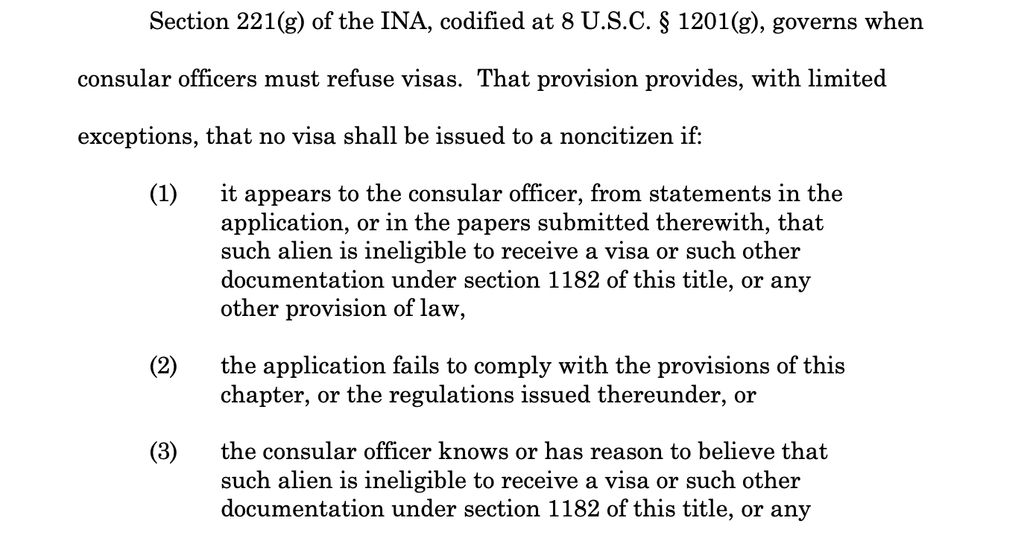
- The policy violates 8 U.S.C. § 1152(a)(1)(A) (nationality-based discrimination ban, rooted in 1965 Civil Rights-era immigration reform), § 1201(g)/22 C.F.R. § 40.6 (mandating refusals absent any actual ineligibility ground), and § 1104(a) (exceeds the Secretary’s statutory authority over visa adjudication). It also violates the Accardi doctrine by contradicting the agency’s own regulations.
- The court found no violation of the public-charge provision (§ 1182(a)(4)) itself, and held notice-and-comment rulemaking wasn’t required since the policy is an internal procedural directive.
- Remedy: full vacatur of the policy (not remand), distinguishing this APA vacatur from the Supreme Court’s Trump v. CASA limits on universal injunctions — because “the Supreme Court clarified its holding did not bear on vacatur of agency action under the APA, […] Plaintiffs are not seeking injunctive relief, only vacatur of the Policy under the APA” (Citing Trump v. Case, Inc., 606 U.S. 83 (2025), page 841- 847).
- Consular officers are required to conduct an individualized assessment of applicants and to refuse visas only to those whom the consular officer finds ineligible, and in dicta, the Judge stated that the old policy had the head of the Department of State overriding consular direction and decision-making, which is found to be unlawful. (see page 17 of 61 of the Order).
- This case found that the Judicial branch had a role to play here expressly authorized by law, because: “Neither the Supreme Court nor the Second Circuit has decided whether the doctrine of consular nonreviewability bars judicial review of APA challenges to executive policies governing consular decisions.” (see page 23 of 61). Finding that the doctrine of consular nonreviwability has no applciation since Plaintiff did not challenge a particular determination, they challenge the executive policy blocking a decision which is a quite clever interpretation. (see page 24 of 61 of the Order).
Net effect: the nationality-based visa suspension for the 75 countries is struck down, and consular officers must resume individualized adjudication.
However, recall that, in Department of State v. Muñoz (2024): The U.S. Supreme Court significantly narrowed the citizen-based constitutional exception. The Court ruled that a U.S. citizen does not have a fundamental due process liberty interest under the Fifth Amendment to have their noncitizen spouse’s visa denial judicially reviewed, further cementing consular discretion.
“Normally, judicial review of visa denials by a State Department consular officer is precluded under a legal principle known as the doctrine of consular nonreviewability, even if the inadmissible person alleges that the decision violated the U.S. Constitution. The Supreme Court has recognized an exception to consular nonreviewability, however, that enables courts to review consular decisions when those decisions are challenged by a U.S. citizen on the basis of that citizen’s own constitutional rights. The scope of this review is limited; the government need show only that the decision was based on “a facially legitimate and bona fide reason.” As another Legal Sidebar has explained, in 2024 the Supreme Court further narrowed that exception in Department of State v. Muñoz, ruling that the exception is not triggered when a U.S. citizen spouse alleges that a consular decision violated the citizen’s rights under the U.S. Constitution’s Fifth Amendment Due Process Clause.” (https://www.congress.gov/crs-product/LSB11451)
Bottom line: cases can now process again, & working with an attorney can likely proove helpful for consular processing to try to avoid a denial from the start.
Sign up for a free consultation today to discuss your case on the main page of this Law Office website.
https://storage.courtlistener.com/recap/gov.uscourts.nysd.657161/gov.uscourts.nysd.657161.83.0.pdf
Pingback: A federal court just struck down Trump's 75-country immigrant visa freeze. Here's what happened, in plain English. - Legal American Dream